|
Back
A Saint on a Pillar, a Stranger on a Flagpole Wexford
Grainstore at Stonebridge
10/15/2026 - & October 20, 23, 25*, 28, 30, 2026
Ailís Ní Ríain: Still, life ... (World premiere)
Eilís Dexter, Cuan Durkin, Eadaoin Hassett, Eiméar Harper, Yasmin O’Reilly (Singers). Brian Mullen (Narrator), Trish Barron, Pat Carberry, Sarah Jane Carthy, Fiona Dempsey, Natalia Domingues, Lorraine Dowling, Claire Harney, Bernadette Honohan, Rosheen Jones, Ann Pius Jose, Fiona McDermott, Raymond Molony, Aileen O’Farrell, Michelle O’Neill, John Scannell, Mairead Sinnott, Flavia Oliveira Waldron (Community cast)
Eleanor Chapman (Viola), Adrian Mantu (Cello), Jennifer Murphy (Violin), Nate Ben Horin, Frasier Hickland (Music directors)
Noeline Kavanagh (Stage director). Louise Manifold (Videography)
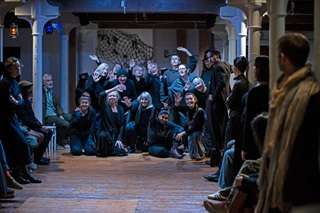
(© Padraig Grant)
Among the more extraordinary figures in the history of Christianity was Saint Simeon Stylites (c. 390‑459), a Syrian ascetic who, dissatisfied with the rigours of conventional monastic existence, sought a more radical form of spiritual renunciation. His chosen abode was the top of a pillar, where he remained for decades, exposed to the elements and removed from the ordinary commerce of human society. Yet the more assiduously he withdrew from the world, the more the world came to him. Pilgrims, supplicants and the merely curious flocked to behold the singular spectacle of a man who had elevated physical isolation into a form of religious vocation. His attempt to escape humanity made him an object of universal fascination.
It is this paradox, though transposed into an altogether more secular and indeterminate register, that lies at the heart of Still, life ..., the new opera commissioned by Wexford Festival Opera for its 75th anniversary. Composer and librettist Ailís Ní Ríain, the festival’s composer‑in‑residence, took as her point of departure Figure Over the Town, a short story by the American writer William Goyen (1915‑1983). Here, an unidentified man climbs a flagpole overlooking a small town and remains there for forty days, declining to explain his behaviour. The townspeople, unable to accommodate an enigma that refuses to yield to conventional interpretation, begin to project their fears, suspicions and desires upon him.
While the Syrian saint stayed on a pole for 37 years, the stranger remains forty days, making the parallel between the stranger and Saint Simeon Stylites even more striking. Though the resemblance to Simeon is immediately apparent, the difference is more consequential still. The saint’s withdrawal possessed an intelligible spiritual purpose, however eccentric its expression might have seemed to his contemporaries. Ní Ríain’s stranger offers no such reassurance. We do not know whether his gesture is an act of protest, an eccentric whim, a spiritual undertaking or something for which the familiar categories of human motivation are simply inadequate. The community’s predicament is thus not merely that it confronts an unusual individual, but that it cannot determine what he means. In a society increasingly impatient with ambiguity, the absence of an explanation becomes an offence in itself.
In the small town, the eccentric stranger thus fulfils the role of the universal scapegoat, as theorised by the anthropologist René Girard (1923‑2015). His outsider status enables the community to project its unresolved anxieties, moral transgressions, and fear of unbridled chaos onto an ambiguous figure, thereby preserving the integrity of its own social bonds. Indeed, a chorus of townspeople accuses him of the murder of a drowned woman. Yet, in a less punitive guise, the stranger serves other, no less revealing purposes: some turn to him to fill the void in their lives, offering, in the words of the magnificent narrator Brian Mullen, “hope to the hopeless and faith to the faithless”—a phrase that encapsulates the paradoxical solace the stranger affords and the anchoring presence of Mullen’s narration throughout the story.
Ní Ríain’s formal response to this premise is as unconventional as its subject. Still, life ... is less a conventional opera than an installation‑opera, combining voices, strings, electronics, video, imagery, text and movement in a semi‑promenade production at the Grain Store at Stonebridge. The choice of venue, a historic building associated with Wexford’s maritime and commercial past, distances the work from the conventions of the proscenium stage. Its unusual theatrical form is integral to its conception: rather than following the familiar trajectory of a protagonist whose motives and transformations furnish the dramatic substance, the opera transfers its attention to those who observe him.
Indeed, the stranger remains the protagonist precisely through his absence from the usual mechanisms of operatic characterisation. The townspeople do the performing; he supplies the occasion. The distinction is both intellectually attractive and theatrically hazardous. A community may become a compelling collective character, but it must not dissolve into an undifferentiated chorus of reactions. The successive stages of its response-curiosity, bewilderment, suspicion and hostility-need to acquire their own dramatic and musical articulation if the initial conceit is to sustain an entire evening.
The participation of local residents alongside professional singers gives this Wexford commission a particular resonance. The community is not merely represented onstage; it participates in the creation of the work. Such involvement is especially appropriate to an opera whose subject is the behaviour of a community confronted with an outsider. Yet the very proximity between the fictional town and the actual one invites a question: can the collective be made sufficiently individual, its members sufficiently distinct, to reveal the different impulses concealed beneath the apparently unanimous demand for an explanation?
The parallel with Saint Simeon also raises a more troubling possibility. The townspeople may believe that they are responding to the stranger, whereas in reality they are responding to their own constructions of him. Once an individual becomes the repository of collective anxiety, the distinction between what he has done and what society imagines he has done begins to disappear. The outsider becomes a convenient receptacle for grievances that may have little to do with him. What begins as curiosity can consequently acquire the logic of persecution.
Luis Bunuel’s Simon del desierto (1965) offers a particularly illuminating comparison. In this surrealist and irreverent film, the Spanish director subjects the ascetic tradition to a mixture of satire, theological scepticism and absurdist humour. Simon’s spiritual renunciation does not prevent the world from turning him into a spectacle; indeed, his very withdrawal attracts the attention from which he seeks to escape. Bunuel’s mordant vision exposes the contradictions by which sanctity becomes entangled with vanity, institutional prestige and the appetite for spectacle. Ní Ríain’s work is less explicitly satirical, but the underlying paradox is shared: the individual who stands apart from society may become the person through whom society’s own contradictions are most clearly exposed.
A further, more unexpected operatic parallel is Hans Zender’s Stephen Climax (1979‑84), whose libretto by Hans Wollschläger juxtaposes the life of Saint Simeon Stylites with James Joyce’s Ulysses. Here, the ancient ascetic and the modern Irish intellectual inhabit radically different worlds, yet both embody forms of estrangement from the society around them. Zender’s enthralling conjunction of Simeon and another Irishman, Joyce, opens a dialogue between spiritual renunciation and modern consciousness, between withdrawal from the world and rebellion against its inherited conventions. Ní Ríain’s work is far more circumscribed in its means, but it belongs to a related tradition of questioning whether separation from society constitutes liberation, defiance or merely another form of imprisonment.
The most telling feature of Still, life ... is ultimately the disproportion between the stranger’s action and its consequences. He climbs a flagpole and remains there, without explanation, for forty days. The town, meanwhile, undergoes a transformation of far greater magnitude than the act that provoked it. His silence becomes an accusation; his immobility generates movement; his refusal to participate in public life draws the entire community into an increasingly feverish engagement with him. The stranger does not need to preach, denounce or even address his observers. Society supplies the drama, and in doing so reveals its own vulnerability to fear, conformity and the intolerable prospect of an unanswered question.
Saint Simeon sought transcendence by rising above the world. Ní Ríain’s stranger may have no such ambition. Yet both demonstrate the peculiar power of the individual who refuses to behave as society expects. The decisive question is not what the man on the flagpole intends, but what his presence compels everyone below to become. In that unsettling inversion of the conventional relationship between protagonist and community lies the work’s most provocative idea: sometimes it is not the outsider who needs explaining, but the society that cannot bear to leave him unexplained.
Ossama el Naggar
|
