|
Back
Flappers, Farce and Forgotten Bel Canto Wexford
National Opera House
10/20/2026 - & October 22, 24*, 26, 29, 31, 2026
Michael William Balfe: The Rose of Castile
Eleri Gwilym (Queen Elvira of León), Erin Fflur (Donna Carmen), Myrna Tennant (Beatrix), Eamonn Walsh (Manuel), Jonah Halton (Don Sallust), Conor Cooper (Don Florio), Rory Musgrave (Don Pedro), Peter McCamley (Narrator)
Rebecca Warren (music director and piano)
Heather Hadrill (stage director), Lisa Krügel (sets and costumes), Cian Redmond (lighting)
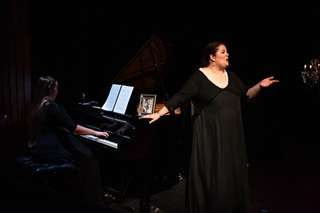
R. Warren, E. Fflur (© Padraig Grant)
Michael William Balfe (1808-1870) occupies a neglected but significant place in nineteenth-century opera. The Irish composer achieved international success and is remembered chiefly for The Bohemian Girl (1843), whose aria “I Dreamt I Dwelt in Marble Halls” has long outlived the stage work. Its popularity points to a composer whose melodic gifts were once widely valued, even if his operas have since vanished from the repertory.
A violinist, singer and composer, Balfe absorbed Italian opera while performing in Paris and studying in Italy before settling in London. His music combines Rossinian melodic fluency and theatrical energy with the lighter manner of French opéra‑comique. This hybrid style offered graceful melodies, vocal display and lively ensembles, but its position between traditions proved precarious. English-language opera lacked the institutional continuity of Italian repertory, and as Victorian tastes changed, Balfe’s accessible theatricality fell from favour.
The Rose of Castile, premiered at London’s Lyceum Theatre in 1857, shows why that disappearance was not entirely deserved. Its connection with Wexford is especially strong: the opera opened the festival in 1951, helping establish its commitment to neglected works. Its return for the festival’s seventy‑fifth anniversary is therefore apt.
The plot follows the familiar comic-operatic pattern of disguises, romantic confusion and political intrigue. Elvira, Queen of León, disguises herself as a peasant to escape an arranged marriage, while Manuel, the muleteer with whom she falls in love, is actually the King of Castile in disguise. Their confusion eventually gives way to recognition and reconciliation. The libretto, based on the French text for Adolphe Adam’s Le Muletier de Tolède (1854), places Balfe’s work firmly within the opéra‑comique tradition.
Wexford presents the opera as a Pocket Opera, reducing it to about an hour. The recitatives are omitted and replaced by a narrator whose hard‑boiled manner recalls film noir. The device is amusing, but it also alters the dramaturgy. Recitative allows characters to react, relationships to develop and musical numbers to emerge from specific situations; here, the narrator explains events that would otherwise unfold through dialogue, music and action. His knowing detachment places another layer between the audience and the characters.
The piano reduction is more limiting. Though practical for a small‑scale production, it reduces the score’s colour and breadth, particularly for the high voices. A keyboard can provide harmony and rhythmic momentum, but not the orchestral textures that frame and support the vocal lines. Balfe’s direct melodic writing survives the reduction better than Stanford’s more intricate music did in Wexford’s reduced Much Ado About Nothing seen the day before, and much of the score’s charm remains. Still, the opera’s vitality would surely increase with its original orchestration and recitatives.
Heather Hadrill’s production relocates the action to the Roaring Twenties, a persuasive setting for its disguises and romantic manoeuvres. Flappers, glamour and social play give the farce a brisk theatrical identity, supported by Lisa Krügel’s sets and costumes and Cian Redmond’s lighting.
The cast handles the production well. Welsh mezzo Erin Fflur is particularly effective as Donna Carmen, the Queen’s dame de compagnie, while Eamonn Walsh brings lyrical ease and animation to Manuel. As Elvira, Eleri Gwilym commands the stage with vivid theatrical instinct, though her high register is not always well supported by the piano. Irish baritone Rory Musgrave is an appropriately villainous Don Pedro. The ensemble contributes strongly to the comedy’s timing and energy, and Peter McCamley’s noir‑inflected narrator frames the action effectively, even as his presence underscores the adaptation’s compromises.
Wexford deserves credit for returning to Balfe and renewing the festival’s historic commitment to neglected repertory. This revival confirms that his melodic immediacy can survive substantial reduction, but it also raises a practical question: how much can be altered before accessibility becomes substitution? The Twenties setting and committed cast make this an attractive introduction, yet the piano, abbreviated dramaturgy and narrator limit the opera’s musical and theatrical range.
The Rose of Castile remains a persuasive example of Balfe’s talent. Wexford makes the case for hearing more of his work, while also showing that genuine rehabilitation will require performances that restore, rather than replace, the score’s original resources.
Ossama el Naggar
|
