|
Back
Emilia’s Choice Lille
Opéra
02/05/2026 - & February 7, 10, 12, 14, 16, 2026
Leos Janácek: Vĕc Makropulos
Ausrine Stundytė (Emilia Marty), Robin Adams (Jaroslav Prus), Denys Pivnitskyi (Albert Gregor), Paul Kaufmann (Vítek), Marie-Andrée Bouchard-Lesieur (Kristina), Jean‑Paul Fouchécourt (Hauk-Sendorf), Jan Hnyk (Dr. Kolenatý), Florian Panzieri (Janek Prus), Mathilde Legrand (Cleaning woman, Hotel maid), Jocelyn Riche (Stage technician)
Koor Opera Ballet Vlaanderen, Orchestre national de Lille, Dennis Russell Davies (conductor)
Kornél Mundruczó (director), Marcos Darbyshire (reprisal stage director), Monika Pormale (sets & costumes), Felice Ross (lights), Kata Wéber (dramaturgy)
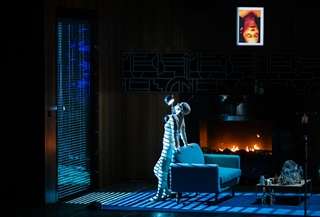
A. Stundytė (© Frédéric Iovino)
The son of a schoolteacher in the region of Moravia, Janácek’s obvious musical talent convinced his father to allow him to pursue a musical career. Never a conformist, he was by all accounts a gifted though perturbed student at the Brno Conservatory and later the Leipzig Conservatory. An enfant terrible, he wrote a scathing review of his teacher’s conducting at the Brno Conservatory, which got him expelled (his teacher later relented, allowing his return). Later in life, another virulent review of an opera by Czech composer Karel Kovarovic gained him the latter’s everlasting enmity. When Kovarovic eventually became Director of the National Theatre in Prague, he understandably refused to premiere Jenůfa there as retribution.
The 1904 premiere of Jenůfa in Brno, Janácek’s first success, took place when the composer (b. 1854) was already middle ged. He’d made his living as a provincial music teacher and organist in Brno, but after Jenůfa’s debut in Prague and its ensuing international success, he embarked on a remarkable second period of productivity, during which he wrote what are now considered to be major works. These works included Káťa Kabanová (1921); The Cunning Little Vixen (1924); The Makropulos Case (1926); From the House of the Dead (1928); Taras Bulba (1921); Sinfonietta (1926); Glagolitic Mass (1927); String Quartet No. 1 “Kreutzer Sonata” (1924); and String Quartet No. 2 “Intimate Letters” (1928). It is believed that the fecund last years of his life were due to his passion for Kamila Stösslová, a young married woman almost four decades years his junior. This unfulfilled passion was channeled into abundant creativity.
While Jenůfa and Káťa Kabanová compellingly chronicle typical rural life in Eastern Europe in the late nineteenth and early twentieth century, Vĕc Makropulos is based on a play by Czech playwright Karel Capek (1890‑1938), the father of modern science fiction. Capek’s R.U.R. (Rossum’s Universal Robots, 1920) introduced the word “robot” to the world.
The story of the opera concerns a 337-year-old woman who was the daughter of Hieronymous Makropulos, alchemist and physician to Holy Roman Emperor Rudolf II (1552‑1612). When the latter asked Makropulos to prepare a potion to prolong life, he forced him to use his daughter as a guinea pig. She fell into a coma, and her father was imprisoned as a charlatan. When the girl awakened a week later, she escaped and had been working as an opera singer, changing identities every generation. As the potion’s effect is slowly wearing off, Elena Makropulos, now known as Emilia Marty, is searching for the formula for a renewed lease on life. It is found in papers left by one of her lovers, whose estate is the subject of litigation between two families, the middle‑class Gregor and the aristocratic Prus families. This is the premise of my favourite of Janácek’s operas.
Like Strauss’ operatic masterworks Salome (1905) and Elektra (1909), Vĕc Makropulos is intense, offering any artistic director infinite opportunities. Though written in a three‑act format, its duration is relatively short, just under two hours. Without intermission (as was the case here), the action is more compact and the drama more intense. Hungarian director Kornél Mundruczó, who recently directed a sci‑fi version of Rusalka in Berlin, opted for an uninterrupted rendition of the opera with marked cinematic flair.
Lithuanian soprano Ausrine Stundytė is an incandescent singing actress who was able to fully portray Mundruczó’s vision of Emilia Marty. As alluring as longevity may be from a certain perspective, it is a curse. Going through the motions, experiencing life with ephemeral morals who perish while remaining “forever young” is no blessing. The director shows Emilia is a jaded woman who has experienced it all and for whom life holds no surprises. With a look of David Bowie, she evokes a creature who’s no longer entirely human. She marvellously falters on occasion, and increasingly so as the opera progresses. Her body is bandaged like a mummy and is clearly tired.
Monika Pormale’s sets evoked modernity in this updated setting. Emilia incessantly consumes energy drinks as a vampire does blood. Her refrigerator, which spits out a cloud of steam whenever opened, was like a Time Machine betraying her secret. A racy video of a drive in the Czech countryside, between Prague and her glitzy country home, symbolized Emilia’s frantic journey from one identity to the next.
Young French mezzo Marie-Andrée Bouchard-Lesieur brilliantly portrayed the ingénue daughter of the clerk Vítek, herself an aspiring opera singer, mesmerized by the glamorous diva Emilia. Progressively, her admiration turns to repulsion as she sees the effect the diva has on men, including her fiancé Janek. Her father Vítek is interpreted by German tenor Paul Kaufmann, who portrayed Vítek as the quintessential tired lawyer/bureaucrat, evocative of Communist Czechoslovakia (despite the updated setting). Likewise, Czech bass Jan Hnyk was a splendid and imposing Dr. Kolenatý, whose law firm had been handling the case opposing Gregor’s and Prus’s families for generations.
Endowed with a powerful voice and passionate delivery, Ukrainian tenor Denys Pivnitskyi was an Albert Gregor totally consumed by love. British baritone Robin Adams was a lustful Jaroslav Prus, consumed by desire. British‑French tenor Florian Panzieri was convincing in his brief turn as his young son Janek, who commits suicide out of desperate love for Emilia. Even old Hauk‑Sendorf, sung by French tenor Jean‑Paul Fouchécourt, loses it over Emilia, whom he’d known as Eugenia Montez, a Spanish gypsy he’d fallen in love with half a century earlier. All these men pine for her, just as a thousand others have, over three centuries. Some of those smitten were even her own descendants, we are asked to believe. Enough!
Stundytė’s final scene was beautifully staged and marvellously acted as well as sung. Mundruczó did not attempt special effects to show Emilia’s demise. Rather, he opted for a poetic interpretation wherein he made Emilia’s choice a quest for peace. As Emilia dies, her modern home crumbles and articles of furniture fly in the air (suspended by unseen ropes) creating a powerful effect. Three centuries, as it turned out, was her sell‑by date.
Ossama el Naggar
|
