|
Back
04/11/2026
“Felix Mendelssohn: Symphonies & Oratorios”
Felix Mendelssohn: Paulus, opus 36 [1] – Elias, opus 70 [2] – Symphony n° 1 in C minor, opus 11 [3] – Symphony n° 2 in B‑Flat major (“Lobgesang”), opus 52 [4] – Symphony n° 3 in A minor (“Scottish”), opus 56 [5] – Symphony n° 4 in A major (“Italian”), opus 90 [6] – Symphony n° 5 in D minor (“Reformation”), opus 107 [7]
Julia Kleiter [1], Golda Schultz [2], Joël Necker [2], Christiane Karg [4], Elsa Benoit [4], Mai Kato [2], Manja Raschka [2] (soprano), Wiebke Lehmkuhl [1, 2], Alexandra Schmid [2], Nadiya Zelyankova [2], Michelle Neupert [2] (alto), Werner Güra [1, 2, 4], Oliver Kaden [2], Falk Hoffmann [2], Yongkeun Kim [2] (tenor), Andrè Schuen [2] (baritone), Georg Zeppenfeld [1], Gun‑Wook Lee [1], Felix Plock [1], Johannes Weinhuber [2], Philipp Brömsel [2] (bass), MDR‑Rundfunkchor, Philipp Ahmann [1, 2, 4] (chorus master), Gewandhausorchester, Andris Nelsons (conductor)
Recording: Gewandhaus, Leipzig, Germany (September 2021 5], November 2021 [2], February 2023 [1], September 2023 [4, 7], May 2024 3, 6] – 458’
Deutsche Grammophon DG 4868178 (Distributed by Universal Music) – Booklet in English and German
 
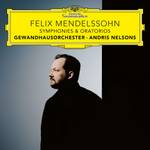
You might say there are three conductors named Andris Nelsons: a sloppy one, a mannered and fussy one, and an engaged, insightful one. Happily, the last of the three predominates in this consistently enjoyable and often impressive Mendelssohn collection. The more popular of Mendelssohn’s symphonies get more than just another run‑through. The“Italian” perhaps comes off best of all. It’s not the most propulsive or viscerally exciting account; there is drama, but it is held back just enough to show off at every moment the breathtaking warmth, delicacy, and precision the Gewandhaus, once Mendelssohn’s own orchestra, wields today. But Nelsons enhances the orchestra’s musicality with his own, frequently asking for soft dynamics with the kind of reflective phrasing that makes you lean in to listen. The “Italian”, while staying for the most part its usual ebullient self, thus acquires a new layer of poignance.
More expressive variety is written into the “Scottish”, and Nelsons gets the same frequently hushed playing here to magical effect. The very opening is arresting, with the Leipzig woodwinds positively aglow. My only quibble, and it really is just a quibble, is that the beginning of the first movement exposition—taken rather slowly, by the way—is a bit rhythmically square. Similarly, the finale of the “Reformation” could use a touch more momentum at times, but otherwise that work benefits from all the interpretive touches mentioned already, which is especially welcome in music that can easily become plodding and stuffy in the wrong hands. As in all fine performances of this piece, it becomes convincingly dramatic and expressive under Nelsons, even if some old‑timers found more electricity (Mitropoulos) or majesty (Karajan) to hide the hints of empty rhetoric.
Symphony n° 1 is even more neglected than the “Reformation”, which is a pity: even if none of the composer’s most memorable material is on display here, it is a well‑constructed and consistently engaging symphony, definitely the work of a major composer and astonishing as that of a fifteen-year-old. Too bad the mannered Nelsons emerges here, inserting a number of distracting dynamic contrasts in passages in the outer movements where the music needs to surge forward. The piece would also benefit from more cutting loose, as beautiful as the playing is. The overall energy level is high enough, but Nelsons missed the chance to deliver a truly outstanding reading of a work that could really use one.
I feel on shakier ground with the choral works, none of which I had heard in some time. In fact—like many listeners, I’m sure—I had never heard Paulus at all. It certainly has its share of arresting passages, and I enjoyed listening for snippets of familiar chorale themes—including the whole of the “Wachet auf” that appears more famously in Bach’s chorale BWV 140. The performance seems robust and engaging, with a nice turn by the notable Wagnerian bass Georg Zeppenfeld in the title role.
Mendelssohn’s oratorios, including the Symphony n° 2 (whose purely instrumental introduction, in three movements, runs a bit short on inspiration after that arresting opening movement), are often dismissed for a certain Victorian sentimentality or banality, and I don’t want to hazard a holistic assessment of these works, which do lack some of the simple sublimity that marks the greatest works of their scale. That said, I remember enjoying Elias in concert many years ago, and Mendelssohn has a knack for stirring chorales; I think the quieter music in these oratorios tends to be not quite as inspired, though it’s all worth hearing. If you want to decide for yourself how unjustly maligned this music is, I suspect it would be hard to do better than Nelsons and company.
Samuel Wigutow
|
