|
Back
Splendid Beauty Milano
Teatro alla Scala
12/18/2025 - & December 21, 28, 31, 2025, January 2, 3, 4, 7, 8, 9, 10, 11, 13, 2026
The Sleeping Beauty
Rudolf Nureyev (Choreography, after Marius Petipa), Sabrina Mallem, Laurent Novis, Béartrice Mariel, Lionel Delanoë (Reprisal choreography), Pyotr Ilyich Tchaikovsky (music)
Nicoletta Manni*/Alice Mariani/Martina Arduino/Camilla Cerulli (Aurore), Timofey Andrijashenko*/Navrin Turnbull/Mattia Semperboni (Le prince Désiré), Chiara Borgia (La Fée des lilas), Francesca Podini*/Giorgia Sacher/Antonella Albani/Chiara Fiandra (Carabosse), Gabriele Corrado*/Daniele Lucchetti (Le roi Florestan), Azzurra Esposito*/Francesca Podini (La Reine), Marco Messina*/Federico Fresi (Le maître de cérémonie Catalabutte), Massimo Garon (Le Duc), Vittoria Valerio (La Comtesse), Denise Gazzo*/Letizia Masini/Giordana Granata (La Chatte blanche)
Federico Fresi*/Andrea Crescenzi (Le Chat botté), Linda Giubelli*/Gala Andreanò (Princesse Florine), Darius Gramada*/Edward Cooper/Saïd Ramos Ponce (L’Oiseau bleu), Corpo di Ballo del Teatro alla Scala
Orchestra del Teatro alla Scala, Kevin Rhodes (conductor)
Franca Squarciapino (Sets & Costumes), Andrea Giretti (Lighting)
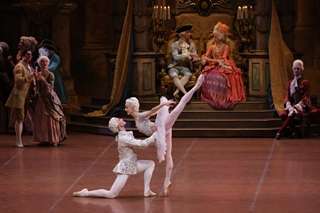
T. Andrijashenko, N. Manni (© Brescia e Amisano/Teatro alla Scala)
The Sleeping Beauty (1890), the second of Tchaikovsky’s three ballets, is much less frequently performed than Swan Lake (1877) and The Nutcracker (1892). It’s also the most “French” of the three; the other two take place in Germany and The Nutcracker is based on Nussknacker und Mausekönig (1816), a tale by German writer E.T.A. Hoffmann (1766‑1822).
Prince Ivan Alexandrovitch Vsevolojsky (1835‑1909), Director of the Imperial Theatres and an ardent Francophile, is said to have specifically chosen the story of Sleeping Beauty by Charles Perrault (1628‑1703), itself based on traditional French fairy tales. Other than his love of France, Vsevolojsky had another agenda: to pay homage to King Louis XIV (1638‑1715), “Le Roi Soleil,” most absolute of absolute monarchs, in a period of counter reformation by Tsar Alexander III (1845‑1894), who was reversing his predecessor’s liberal reforms.
Given this clin d’œil to King Louis XIV, The Sleeping Beauty involves the most luxurious – almost Rococo – sets of the major ballets. The expense of mounting such ornate sets and costumes is the main reason for its infrequent performance. This production boasted the majestic sets and lavish costumes of Franca Squarciapino. Though several decades old, the sets and costumes were so beautiful and elaborate that one could be forgiven for thinking it was a brand new production.
Legendary dancer-choreographer Rudolf Nureyev (1938‑1993) considered The Sleeping Beauty the “ballet of ballets.” When he conceived this production, he infused it with some consequential elements: he insisted its considerable length be respected; he directed Franca Squarciapino to refashion costumes he considered too cumbersome; and (as was his wont), he amended the choreography to favour the male dancers, especially that of Prince Desiré. Latvia’s Timofey Andrijashenko, recently admired in La Scala’s production of La Bayadère, is a regular star dancer at La Scala. He was up for the challenges of the role, especially in Act III, where he performed dizzyingly high jumps, though he started the first jump on a poor footing, which is easily forgiven given the ensuing bravura.
The part of Princess Aurore is not as significant as that of Giselle or Odette/Odile in Swan Lake. In part, this is because Aurore is a baby in the Prologue and in deep sleep in much of Act II (though the good Lilac Fairy makes her appear as a vision to Prince Désiré). Grace and elegance characterise the part more than bravura, and here, Nicoletta Manni was an ideal Aurore, delicate and expressive. Starring in La Scala’s recent productions of Paquita and Coppéliai, Manni is a paragon of elegance, renowned for her brilliant technique. Regularly partnered with Andrijashenko, their great chemistry was palpable. They dazzled in Act III’s pas de deux, possibly the most memorable and romantic number in the ballet.
When Francophile Prince Vsevolojsky suggested the story to Tchaikovsky and Marius Petipa, he insisted on including various characters from Perrault’s tales: Puss in Boots, Bluebeard, Tom Thumb and Cinderella. In his 1989 choreography, Nureyev did away with most, save Puss in Boots and his female partner, La Chatte blanche. Though the steps of both roles are not the most difficult, they provide humour in this rather serious ballet. Denise Gazzo and Federico Fresi were both adorable and naturally charming felines.
Squarciapino’s costumes were truly magnificent, especially those for the King and Queen. In this choreography, Aurore and the courtiers, frozen in time, return to life as they were before the sleeping spell. However, the King and Queen aged considerably, indicating the impending ascension of Aurore and Desiré to the throne.
The actions of the good Lilac Fairy and the evil fairy, Carabosse (interpreted respectively by Chiara Borgia and Francesca Podini) will forever remain in the audience’s memory. Firstly, Carabosse is annoyed at not having been invited to Princess Aurore’s christening, therefore casting an evil spell on the infant, to die on her sixteenth birthday, pricked by a spindle. The Lilac Fairy counters the spell but cannot reverse it; Aurore falls into a deep slumber for a hundred years, until awakened by the kiss of a handsome prince. Secondly, the costumes for both were magnificent. Carabosse’s black dress stood out among the bright colours of the rest of the costumes. As for Carabosse’s horned familiars, they were truly scary. The pantomime between the two fairies, often a source of comic relief, was measured in this production, always preferable to forced humour.
Comic relief was abundantly provided through the character of Catalabutte, the Court’s Master of Ceremonies, portrayed by the expressive Marco Messina, who forgot to invite Carabosse, thus causing further rage and malevolence. Though not a technically demanding role, it’s a rôle de caractère like character roles in opera, not technically demanding but dramatically significant. Unlike other productions, facial expressions conveying his preciousness, short temper and unctuous nature were favoured. This is a much more dignified choice than the usual overly effeminate mannerisms, mercifully eschewed here.
Oddly enough, in The Sleeping Beauty, the most memorable part is one who isn’t an essential character, L’Oiseau bleu (the Blue Bird), here danced magnificently by Darius Gramada, whose moves in Act III are one of the ballet’s most exquisite. There is a famous account by Bronislava Nijinska (1891‑1972) of her brother Vaslav Nijinsky (1890‑1950) managing to have the costume modified to allow him to have freer arm movements that enabled him to jump higher and more freely, giving the illusion of flight. By removing the restricting wing contraption sewn into his costume, he was able to achieve the right balance in his movements, using his arm as well as his leg muscles. With free arms, the balance is achieved and Blue Bird truly flies. L’Oiseau bleu and his acolyte, danced by Linda Giubelli, Princess Florine, are guests at the palace, disguised as blue birds for the court and the public’s entertainment.
American conductor Kevin Rhodes, a specialist in ballet, previously heard in ici La Scala’s revival of Nureyev’s La Bayadère. As in Minkus’s ballet, Rhodes conducted the Orchestra del Teatro alla Scala with panache and elegance. Rhodes has an obvious feel for the art form, providing musical support of the highest calibre.
It’s a delight to have seen three versions of The Sleeping Beauty in one year: the aforementioned Parisian production; Martin Schäpfer’s iconoclastic choreography for Vienna; and the present one. Though both Paris and La Scala’s productions are choreographed by Nureyev, I prefer the latter. Some of the dancers may have been marginally better in Paris, but La Scala’s production had more cohesion. The dazzling sets were better preserved than those in Paris. This may relate to adjusting the sets conceived for Palais Garnier and the different one for Opéra Bastille. The costumes and sets at the present Milanese production were truly stunning, so well preserved that the production could pass for brand new. Though some advocates of modern dance may not agree, kudos to La Scala for its care and attention to detail in preserving and reviving the choreographies of Nureyev, one of history’s greatest ever dancers and choreographers.
Ossama el Naggar
|
